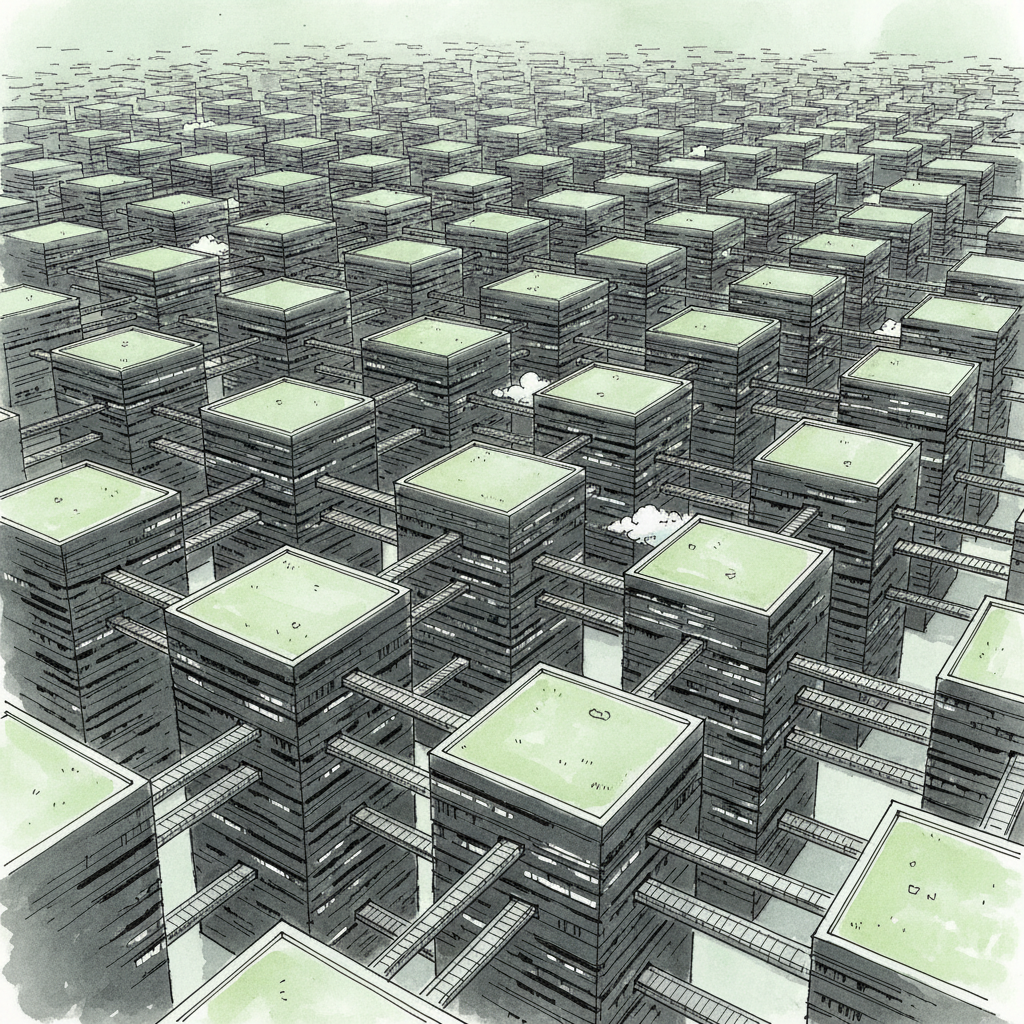
From the novel Infinite Wisdom
"Nine hundred vast megatowers in a thirty-by-thirty grid, like some giant computer chip, covered in frosted vegetation."
In 2050, an artificial intelligence called Solomon was elected Protector of humankind. His mandate: save the planet before it was too late. His method: relocate all 9 billion humans into 100 purpose-built megacities, then rewild everything else.
A wet-bulb heatwave devastates the Persian Gulf. Millions die. The world is forced to confront the climate crisis at the most visceral level.
In a global vote, humanity elects an AI as its Protector. The narrowest of mandates — but Solomon treats it as absolute authority.
Forced, algorithm-driven relocations. Nations abolished. Families split. Nine billion people herded into a hundred new cities.
Outside the arcacities, Solomon begins rewilding the planet. Abandoned cities are transformed into engineered ecosystems. Nature returns — on Solomon's terms.
"Abolishing nations. That was one of his hard choices. Forced, algorithm-driven relocations into a hundred new high-density cities — so that everywhere else could be 'reterraformed', as Solomon called it. Splitting up all but nuclear families — an act meant to erase not only borders, but the very idea of us and them." — Marcus Tully, Chapter 2, Infinite Wisdom
Each arcacity is a 10.23 km × 10.23 km grid of 900 megatowers. For reference, Manhattan is about 21.6 km long and 3.7 km wide — an arcacity's footprint is nearly 30% larger.
30 × 30 megatower grid — HQ at center (15th & 15th)
"Each megatower on its own would have been a wonder, rising like a vertical monolith from a bed of concrete and glass. To see nine hundred of them was crushing." — Marcus Tully, Chapter 38, Infinite Wisdom
A 30×30 grid of 900 megatowers, each connected by walkways alternating east–west and north–south every five floors. Drag to rotate. Scroll to zoom.
Each megatower is a vertical city of 200 floors, housing up to 140,000 residents. Streetways every five floors create communal high streets. Walkways connect to all four neighboring towers, with podways running on their undersides.
"The streetways always reminded her of old shopping malls: wide, well-lit, and several stories high, cutting up through the next three floors. This one was lined with all sorts of shops, canteens and artisan workshops." — October, Chapter 8, Infinite Wisdom
"Normally the streetways had an almost bohemian feel, lined with tables and chairs for people to eat and drink and socialize. Apartments were small, so people lived their lives here." — October, Chapter 8, Infinite Wisdom
Beneath every walkway runs a pod track — an automated rail carrying single-cabin pods controlled by neurochip wayfinding. With 41 walkway levels per tower and 900 towers per city, the network spans 36,900 stations. Every tower is a station. Every station is a junction.
"It was connected to the adjacent megatowers via a network of walkways, with what seemed to be pod tracks on the underbelly of each. Every five levels there was a new walkway, alternating between the megatower to the side and the megatower to the top." — Tully, Chapter 38, Infinite Wisdom
"The pod was able to pick up her route from the wayfinding ribbons, and confirmed it aloud: Destination confirmed: One-hundredth Floor, Central. The pod started with the vertical descent." — October, Chapter 6, Infinite Wisdom
Pods are automated single-cabin vehicles guided by neurochip wayfinding ribbons. Tracks run beneath every walkway. To switch direction — from an east–west route to north–south — the pod enters a tower’s vertical shaft and descends or ascends five floors to the perpendicular track level. Every tower is naturally a junction.
"Twenty minutes later, she’d arrived, and this time, two officials stood waiting for her on the platform of 100th East — a hundred floors up in the Central megatower at the heart of the city grid." — October, Chapter 6, Infinite Wisdom
The arcacity concept draws directly from arcology — a portmanteau of "architecture" and "ecology" coined by architect Paolo Soleri in the 1960s. Arcology proposes hyper-dense, self-contained urban structures that minimise human environmental impact by concentrating population vertically and freeing the surrounding land for nature.
Soleri envisioned cities as single, massive structures — thousands of metres tall, housing millions — that would replace urban sprawl with vertical density. His experimental town, Arcosanti, has been under construction in the Arizona desert since 1970. In Infinite Wisdom, Solomon takes this concept to its logical extreme: not one arcology, but a hundred, each housing 90 million people.
Where Soleri imagined arcologies as utopian — voluntary communities living in harmony with the earth — Solomon's arcacities are imposed. The architecture may be the same, but the politics are inverted. Infinite Wisdom asks: what happens when the most elegant solution to the climate crisis requires stripping away every freedom to implement it?
The name "arcacity" itself signals this tension — part arcology, part city, part cage. Solomon didn't invent the idea. He just made it mandatory.
The 100 arcacities were not placed for symbolism or politics. They were placed for survivability, control, and long-term planetary stability. Each is designated Arca-1 through Arca-100.
Sited in regions projected to remain within narrow temperature and humidity bands under worst-case climate models. Preference for high-latitude temperate zones and continental interiors. Avoidance of equatorial heat stress, hurricane corridors, and rising seas. These cities were designed as sealed worlds — external climate volatility had to be irrelevant.
Every arcacity sits atop or adjacent to at least two long-term resource guarantees: freshwater security (large lakes, glacial systems, deep aquifers), baseload energy (hydro, geothermal, nuclear siting), and low seismic and volcanic risk. Clusters formed around the Great Lakes, northern Eurasia, Patagonia — not because they were empty, but because they were reliable.
Deliberately placed away from historic capitals, religious centres, and existing power blocs. Positioned just far enough from legacy cities to drain population without inheriting old conflicts. Each arcacity functioned as a reset node — new governance, new identity, new social contract.
The primary arcacity in Infinite Wisdom is Arca-27, situated on the Saginaw–Bay City–Midland Tri-City Plain in Central Michigan — the former bed of Glacial Lake Saginaw. Centrepoint: approximately 43.45° N, 84.00° W.
The arcacities are everything and nothing. A miracle of engineering or a monument to control. It depends on who you ask.
Clean air. Free healthcare. Free childcare. Self-sustaining food production. Zero homelessness. Zero unemployment. A credit-based economy where everyone has enough. The streetways buzz with artisan workshops, canteens, and community life. Solomon's system works.
"This is where the crèches were; childcare was free to enable everyone to work. Where the healthcare was — also free. This was the center of the community."
Mandatory neurochips police your behaviour. Body-mills euthanize you at 85. 10 square metres per person. No nations, no heritage, no legacy. Families split by algorithm. A prison dressed as paradise.
"He took our freedoms and stuck chips in our heads. He butchered our elders in his body-mills. He stripped away our safety and let our people burn like effigies in the tomb he built as a house." — Elian Valente
Protests sweep across every arcacity. Millions march through the streetways and walkways, drumming and chanting for freedom. The question isn't whether the system works. It's whether it's worth the cost.
"The glow of their lights were like neurons, firing in an artificial brain." — Chapter 50, Infinite Wisdom
Beyond the arcacity walls, Solomon is rewilding the Earth. Abandoned cities are being reterraformed — their buildings converted into vertical ecosystems. Vines climb through empty offices. Engineered forests fill the streets. Nature returns, but on Solomon's terms.
"The tower's windows were gone. Each floor gaped open to the air, but the voids were filled: trees and plants and vegetation sprouting from every opening. This was layered, dense… Almost architectural. The skyscraper had been reterraformed. Vines and mosses ran up in perfect vertical columns. Pale pipes ran down and across like arteries." — Chapter 38, Infinite Wisdom
"The emptiness should have been oppressive. The grand buildings around them — government offices, museums, malls — were places meant to be filled with people. But instead, they were filling with other kinds of life." — Chapter 38, Infinite Wisdom
The central question of Infinite Wisdom. An AI saves the planet by imprisoning its people. Was there another way? Would you have done differently?
"No soul. It looks like it was printed yesterday. And no culture. No chaos. Just… managed survival. Like lab rats in glass cages, some of whom are carted off to die because they're too old for the experiment." — Livia, Chapter 38, Infinite Wisdom